
THE FABRIC OF THE RESISTANCE
2023-2025
Film, research, textiles, architecture
Yavoriv, Ukraine
The Fabric of the Resistance investigates the entanglement of ecological destruction, cultural erasure and acts of making within the landscapes of Ukraine. Responding to ecocide produced through war and histories of imperial exploitation, the project asks how environmental repair might become inseparable from the preservation of cultural memory. Through landscape research and collaboration with Ukrainian lizhnyk weaver Natalia Kishchuk, weaving emerges as both material practice and language of resistance: a means of recording damaged landscapes while sustaining forms of knowledge, identity and collective memory threatened by war.
Woven Through Time, 2024
Handwoven lizhnyk · Carpathian wool
Designed by Ellena Pointer · Woven by Natalia Kishchuk, Yavoriv, Ukraine


A TAPESTRY OF TOXICITY
War transforms the landscape long after the immediate act of violence ends. The project examines ecocide, which is the deliberate or negligent destruction of the natural environment, increasingly understood through calls for its recognition as an international crime. Mapping chemical contamination, damaged wetlands, radioactive landscapes and biodiversity loss reveals ecocide as a spatial condition extending across soil, water and living systems.


Болото. Полесье, 1890
‘Marsh. Polissia’
Ivan Shishkin

The Pinsk Marshes, 1888
Pierre Foncin - Géographie historique
THE TOXIC LEGACY OF THE BREADBASKET
The Pinsk Marshes form part of Polesia, one of Europe’s largest remaining wetland landscapes. Their history reveals how environmental transformation can become entangled with political and economic systems of control. Large areas of wetland were drained under Soviet rule to convert marshland into productive agricultural territory, disrupting hydrological systems and degrading peatland ecologies. Subsequent extraction and exploitation have continued to reshape the landscape. The marshes therefore become emblematic of a longer history of ecocide: landscapes repeatedly altered, depleted and reorganised according to imperial demands. Read alongside the environmental destruction of the present war, these accumulated scars reveal ecological violence not as a singular event, but as a process unfolding across generations.


Drafting, 2024
Film still, The Fabric of the Resistance
ALTERNATIVE WAYS OF READING THE LANDSCAPE
Alongside environmental mapping, the research examined how artistic and folk practices can resist forms of cultural erasure, preserving relationships to landscape, identity and collective memory through acts of making. Environmental knowledge is not held only within maps, datasets and scientific records. It is also carried through practices developed through sustained relationships with landscape: through material, gesture, memory and traditions transmitted between generations. Against histories of ecological and cultural erasure, making can therefore become a form of knowledge production and resistance.


WEAVING AS A RESISTIVE PRACTICE
The project turns towards Hutsul lizhnyk weaving as one such practice. Rooted in the landscapes of the Ukrainian Carpathians, its materials, symbols and techniques carry inherited ways of understanding land and identity. Weaving becomes not simply a means of representing a landscape, but a way of knowing, remembering and carrying it forward. By engaging with weaving as a tool of slow observation, a language of resistance is made tangible.
THE FABRIC OF THE RESISTANCE
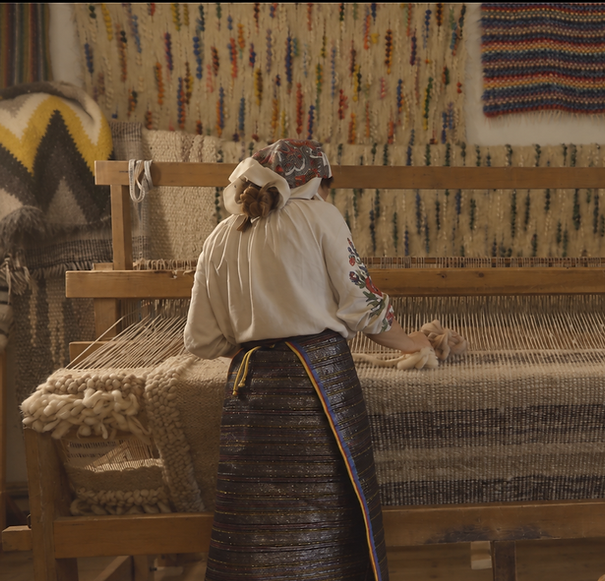
This inquiry developed through collaboration with Natalia Kishchuk, a lizhnyk weaver from Yavoriv in the Ukrainian Carpathians. Through conversation and making, Natalia described her practice, where knowledge is carried through the body through inherited techniques, material intuition, pattern, memory and song.
During the Russo-Ukrainian war, continuing lizhnyk weaving has taken on renewed significance. Refusing to surrender Ukrainian tradition in the face of war, lizhnyk blankets are sent to the front line to keep soldiers warm. The preservation and transmission of the craft itself becomes an assertion of cultural continuity against forces of destruction and erasure.

Natalia Kishchuk, 2024
Film still, The Fabric of the Resistance

Narrative Study, 2024
Digital line drawing

Landscape Study, 2024
Digital collage

Textile Study, 2024
Mixed media
LIZHNYK DESIGN COLLABORATION
Through this collaboration, a design was developed to translate Ukraine’s ecological and cultural histories into the material language of the lizhnyk. Beginning as a continuous narrative landscape, successive iterations gradually abstracted figurative scenes into a composition that could be interpreted through weaving. Landscape, history and memory are translated into fields of colour and geometric motifs. This includes the lozenge, square and repeated patterns associated with land and natural cycles, allowing multiple histories to coexist within a single woven surface.



WOVEN THROUGH TIME, 2024
Handwoven lizhnyk · Carpathian wool
1.2m x 2.5m
The final composition was shared with Natalia, who translated the design through the material and technical processes of lizhnyk weaving. Through wool, colour and inherited technique, the drawn landscape became a physical textile.
THE FABRIC OF THE RESISTANCE, 2024
Experimental film · 10 min 47 sec
The Fabric of the Resistance extends the narrative of Woven Through Time into moving image. The histories encoded within the lizhnyk unfold through landscape, testimony, music and making, moving between histories of imperial erasure, ecocidal destruction and the continuation of Hutsul weaving. Through film, the textile becomes both artefact and narrative device, carrying ecological and cultural memory while positioning the continuation of traditional craft as an act of resistance.

Woven Through Time: Painted Landscape, 2024
Emulsion paint on canvas
1.5 × 2.5 m


The painted landscape was constructed as a visual apparatus for the film. Through close framing, movement and sequencing, individual fragments of the landscape are transformed into a series of spatial and narrative scenes.


POLITICAL ECOLOGIES OF TOXICITY, 2024
11th Arquiteturas Film Festival · Porto, Portugal
The Fabric of the Resistance was exhibited as part of Political Ecologies of Toxicity at the 11th Arquiteturas Film Festival in Porto, Portugal, in 2024. The group installation brought together work from the Royal College of Art’s ADS11 studio, exploring the entanglement of environmental toxicity, political violence and ecological futures through architectural and moving-image practices.

Selected References
Boyd, L. A. (1937). Polish Countrysides. New York: American Geographical Society.
Briukhovetska, O. (2023). Songs and Flowers for Ukraine. MFA Thesis, Penny W. Stamps School of Art & Design, University of Michigan.
Global Tapestry of Alternatives (n.d.). Global Tapestry of Alternatives.
Kishchuk, N. (2024). Interview and collaborative correspondence with Ellena Pointer on Hutsul lizhnyk weaving, Yavoriv, Ukraine.
Nixon, R. (2011). Slow Violence and the Environmentalism of the Poor. Cambridge, MA: Harvard University Press.
Pardo, A. (ed.) (2023). RE/SISTERS: A Lens on Gender and Ecology. Munich: Prestel, in association with Barbican Art Gallery.
Pigott, A., Jones, O. and Parry, B. (eds.) (2023). Art and Creativity in an Era of Ecocide: Embodiment, Performance and Practice. London: Bloomsbury Visual Arts.
Turns, A. (2023). The Toxic Legacy of the Ukraine War. BBC Future.
Ukrainka, L. Flowers, and More Flowers, There Can Never Be Too Many Flowers… Trans. Jeffrey Stephaniuk.
Parajanov, S. (dir.) (1969). The Colour of Pomegranates. [Film].
Tarkovsky, A. (dir.) (1986). The Sacrifice. [Film].
Special thanks to Natalia Kishchuk for her generous collaboration throughout the project and for translating the design into the traditional craft of lizhnyk weaving; to Artem Oslamovskyi for interpreting my conversations with Natalia; to Maiia Horshkova Vadimovna for translating the film script into Ukrainian; and to Anton Oliynyk for filming Natalia and the lizhnyk-making process in Ukraine.