A TOXIC LEGACY
Updated: Oct 2
Domestication, Colonisation and Care at the Sellafield Nuclear Facility
Sellafield, UK · 2025
A critical essay examining how care, domestication and colonial logics shape the environmental and political landscape of Sellafield, and the long temporalities of its nuclear legacy.

“Nuclear sites are both a manifestation of human control over nature
and a site of deep ecological and temporal dislocation, where
the very idea of care becomes entangled with the failure to fully
manage the long-term consequences of technological intervention.”
(Carpenter, 2016, p. 47)
The ethics of care in the context of the nuclear landscape is a phenomenon deeply entangled with the politics of domestication. Sellafield nuclear facility (Figure 1), located on the west coast of Cumbria in the United Kingdom, exists as a site that portrays the intertwined relationship between practices of care and domestication within the realm of nuclear sites. Originally established for military purposes and mass energy production across the UK, the site has since fallen into a state of severe disrepair, leading to future consequences of an existential scale. This site holds the toxic legacy of nuclear waste, with buried contamination set to persist there for over a century when the site is eventually decommissioned in the year 2140. Sites such as Sellafield represent the transformation of natural ecosystems into hazardous, industrialised environments. Nuclear sites ‘are haunted landscapes, where the residues of technological ambition persist as both material and ethical dilemmas’ (Schwab, 2020). When viewed through the lens of care, a topological analysis can be used to frame Sellafield as an example of the profound spatial, ecological and ethical challenges that the domestication of nuclear sites brings forward.
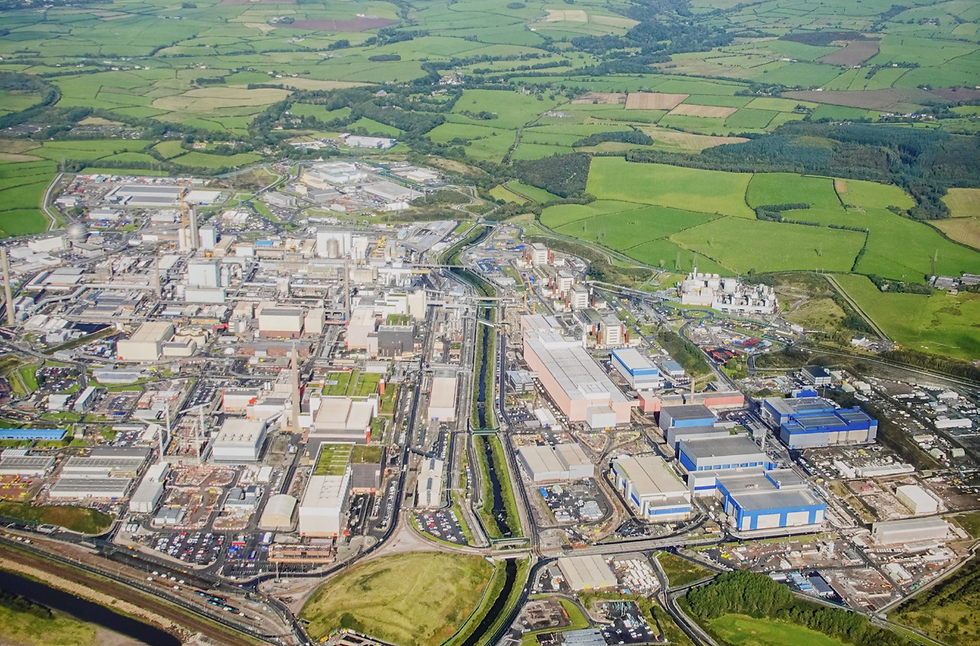
The paradox at the core of domestication can be critically analysed through varying perspectives. Wallace Heim, in ‘The Times of Caring in a Nuclear World’ explores care as a temporal and spatial practice that situates care in the context of toxic legacies (2021). Alongside this, Elizabeth Grosz highlights geological and aesthetic entanglements that offer a framework to propose a methodology for how our engagement with nuclear sites can be shaped (2004). While immediate human needs such as the requirement for renewable energy are satisfied through nuclear infrastructures, such sites perpetuate unequal exposures to toxicity and segregate specific communities who live in and around these sites. By examining these spatial practices, care can be explored as a counterpoint to the inherent violence within nuclear domestication, and invite critical reflection on the ethics of care in nuclear contexts.
Sites such as Sellafield represent a place where the promises of nuclear power have been replaced by the harsh reality of its ecological consequences. It is also emblematic of ‘slow violence’ (Nixon, 2011), whereby ‘the gradual and less visible brutalities that toxic communities endure over time’ are made clear (Bickerstaff, 2022). Nuclear technology has many ecological, spatial and socio-political implications, of which the Sellafield nuclear power plant embodies. Built in the aftermath of the Second World War, the site was developed at the end of the 1940s as part of a widespread initiative to produce plutonium for nuclear weapons. Therefore, the legacy of the site is firmly grounded in military interests. This military imperative directly influenced the architecture and the running of the site, and Cumbria was chosen as a location due to it being deemed by the government as having ‘a strong local workforce, remote and had a good water supply from the River Calder’ (UK Government, 2018). The site is sparsely populated, an ideal context chosen to minimise the risk to the British population in case of a nuclear accident.
In 1957, a catastrophic incident occurred at Sellafield, formerly known as Windscale. The Windscale disaster, as it was infamously known, was a terrible accident that occurred in one of the reactors that produced plutonium. In the decades after this, Sellafield continued to focus on energy production, as the UK government had an unwavering focus on delivering renewable energy. Nuclear power was firmly at the forefront of this strategy.
By the 1980s, Sellafield had significantly developed, expanding in both scale and scope to contain fuel reprocessing, waste management and decommissioning. Today, Sellafield is the largest stockpiler of plutonium in the world, as well as focusing on the long-term management and storage of radioactive waste (The Beacon Museum, 2024). The surrounding Cumbrian landscape has been severely impacted by Sellafield’s transformation from a military base to a constantly expanding industrial complex, which has developed significantly over time (Figure 2). There is a stark contrast between the picturesque natural beauty of the surrounding Lake District coastal terrain and the ominous visual language of the nuclear infrastructure that resides there.

The site is dominated by cooling towers, processing plants and storage silos, situated in direct opposition to the wild, rugged landscapes of Cumbria. As resident Mary Kipling asserted, 'so long as Sellafield stays safe, you’ve got a wonderful environment (around) here ... about the worst stuff that you’ve got pollution-wise is traffic.’ (Davies, 2012). The industrial colonisation of this landscape symbolises a broader reconfiguration of ecological systems, as the demands of the nuclear infrastructure here rely on harnessing precious land and water resources of the surrounding context.
Additionally, there has been a large socio-economic impact on local communities. Sellafield employs many local people, as it is one of the largest employers in Cumbria, supporting 58,643 jobs (UK Government, 2022) in a range of roles, spanning from apprentices to high-paying technical jobs such as industrial engineers. However, the environmental risks caused by the presence of nuclear waste and the sinister long-term consequences of radioactive contamination mean that the legacy of these materials counteracts such prosperity. Communities have voiced their concerns about the toxic implications towards people living near such a dangerous site, with activist groups such as Cumbrians Opposed to a Radioactive Environment (CORE) campaigning against the underground dumping of nuclear waste (CORE, 2020).
The notion of domestication offers a compelling framework to analyse Sellafield as a spatial and ecological phenomenon. Domestication can be defined as the ‘remaking of the conditions of life for both human and non-human entities through processes of mutual accommodation and transformation’ (Ingold, 2000), underscoring the role of domestication in changing natural systems to suit human priorities. Concerning Sellafield, domestication manifests as reconfiguring ecosystems to suit the agenda of energy production, national security and the containment of radioactive materials.
The architecture of the site is dominated by industrial and functional forms, a space designed for the risk of radioactivity to be contained. However, this aspect of control is unreliable, as the chance of environmental damage is high, evidenced by the recent report from the National Audit Office that 2100 litres of radioactive water are currently leaking from the Magnox Swarf Storage Silo each day (2024). Therefore, the boundaries between domesticated and uncontrolled environments are blurred and contested, and this is further evidenced by the ecosystem transformation here. Waterways such as the River Calder were redirected, cooling systems have been integrated with surrounding natural water sources, and land continues to be cleared to facilitate the expansion of the site. These modifications reflect a logic of colonialism, where natural systems are subordinated to allow the production of energy instead.
,
The domestication of Sellafield is not only a technical process, but a socio-political act of colonial logic. It directly involves the exploitation of natural resources through prioritising national goals, leading to significant risks to the local community and disproportionately affecting marginalised groups who live under the constant threat of contamination. Furthermore, Sellafield’s long-term radioactive waste storage plan is a key example of temporal colonisation, placing a burden on future generations who will face ecological and ethical consequences.
The profound challenge of managing nuclear waste is a responsibility that transcends the notion of time, as the permanence of
radioactivity extends far beyond human lifespans. Wallace Heim also highlights the tension between technological containment and
ecological neglect. Care ‘may be an act of resistance’ (Heim, 2021) fundamentally situating care as not only a human concern but also
firmly grounded in the environment we inhabit. Care embodies ‘everything that we do to maintain, continue and repair “our world” so that we can live in it as well as possible. That world includes our bodies, ourselves, and our environment, all of which we seek to interweave in a complex, life-sustaining web’ (Puig de la Bellacasa, 2017). While Sellafield’s infrastructure aims to contain the radioactive, the operations there illustrate an uneven distribution of care. This highlights the limits of technological solutions in their ability to provide a framework to address the insecurity of nuclear legacies.
Through a slightly different lens, Elizabeth Grosz makes further connections between geological, human and also aesthetic dimensions of care. Nuclear waste is a material resistant to domestication and ultimately defies temporal and spatial frameworks. She argues that artistic ways of representing the nuclear are important in making these invisible dangers perceptible (Grosz, 2004) and forging connections between human understanding and reality. These artefacts are temporal markers, highlighting enduring contamination while encouraging individuals to reflect on duties of intergenerational care that transcend the human lifespan. These artefacts could take the form of films, exhibitions or sculptures. For example, Heim showcased the exhibition ‘x=2140’ (2020), which involved designing a series of sculptural fonts to explore care in the context of a radioactive environment. Through an interdisciplinary approach, a collaborative way of working can be established, proposing care as a multi-faceted practice and not only an isolated human endeavour, acknowledging entanglement with the world around us. Sellafield exemplifies the need to redefine the notion of care in nuclear contexts, as fostered collaboration and shared accountability are argued to be key to proposing new ways of embracing the task of managing a nuclear future.
However, stark social inequalities must also be considered when proposing a collaborative methodology of care. Peter Sloterdijk critiques the ideas proposed by both Heim and Grosz, challenging the protective logic of large-scale infrastructures such as Sellafield and how the rhetoric of care can mask inequality. The structural logic of exclusion inherent in these systems prioritises certain groups while excluding others, as ‘immunological systems are not designed to include everything; they are built to protect interiors by externalising the risks and burdens, often to the detriment of the periphery’ (Soterdijk, 2016). Workers often live in the vicinity of these nuclear sites and are therefore disproportionately exposed to radioactive risks and hazardous activities needed to maintain these sites (Figure 4). While workers are exposed, decision-makers in government and corporate institutions are shielded from harm, perpetuating a systemic divide. Sloterdijik’s theory cements how such spatial divides are at the heart of immunological systems, and these are inherent to the ‘successful’ functioning of such systems. This disparity could be reflective of a broader colonial logic within nuclear infrastructures. An extractive relationship is present, as toxicity and risk are imposed on landscapes and communities who live in the shadow of sites such as Sellafield. This is done so without consent, and landscapes and ecosystems have no choice but to absorb the toxic legacies of nuclear contamination. Sloterdijk’s critique reaffirms how the rhetoric of care can be potentially harmful in masking inequality, framing exploitation as a necessary element of the nuclear system.

Sellafield is a pivotal example of domestication leading directly to dire consequences for both people and the environment. A site such as this exemplifies the entanglement of both care and violence in domestication processes. While the site embodies the attempt to contain nuclear material, the fragility of the whole enterprise is revealed through time. Alternative creative practices and new knowledge production are needed moving forward to challenge the colonial and capitalist-centric paradigms of nuclear management and containment.
Despite critical arguments against incorporating dimensions of care as a form of social and environmental remediation, care can be
re-imagined as a practice to counteract colonial narratives. Care can become a framework capable of transforming domestication
rather than imposing control on marginalised bodies. Care can embody stewardship, seeking to acknowledge the entanglement of
interconnected futures. Grosz’s idea of the connection between the geological, the human and the aesthetic provides a new way of
envisaging an interconnected future through new forms of engagement with nuclear contexts.
REFERENCES
Bickerstaff, K. (2022). Living on with Sellafield: Nuclear infrastructure, slow violence, and the politics of quiescence. Transactions of the Institute of British Geographers, [online] 47(4), pp.955–970. doi: https://doi.org/10.1111/tran.12540.
Carpenter, E. (2016). The Nuclear Culture Source Book. London: Black Dog Publishing.
Caren, V. (2021). Sellafield Stories, North West Sound Heritage. Available at: https://northwestsoundheritage.org/2021/05/11/uap030-sellafield-stories/ (Accessed: 10 December 2024).
CORE (2020). CORE – Cumbrians Opposed to a Radioactive Environment. [online] Corecumbria.co.uk. Available at: http://corecumbria.co.uk/.
Davies, H. (2012). Sellafield Stories. Constable.
Grosz, E. (2004). The Nick of Time Politics, Evolution, and the Untimely. Duke University Press.
Grosz, E.A. (2008). Chaos, territory, art: Deleuze and the framing of the earth. New York, NY: Columbia University Press, Cop.
Heim, W. (2020). WALLACE HEIM | X = 2140. [online] Available at: https://wallaceheim.com/x2140/ [Accessed 17 Dec. 2024].
Heim, W. (2021). The Times of Caring in a Nuclear World: Sculpture, Contamination and Stillness. Arts, 11(1), pp.7–7. doi: https://doi.org/10.3390/arts11010007.
Ingold, T. (2000). The perception of environment: essays in livelihood, dwelling and skill. New York: Routledge.
Law, E. (2018). What is Sellafield? - Cleaning up our nuclear past: faster, safer and sooner. [online] nda.blog.gov.uk. Available at: https://nda.blog.gov.uk/what-is-sellafield/.
National Audit Office (2024). Decommissioning Sellafield: managing risks from the nuclear legacy. Department for Energy Security & Net Zero, Nuclear Decommissioning Authority, p.9.
Nixon, R. (2011). Slow Violence and the Environmentalism of the Poor. Cambridge, MA: Harvard University Press.
Puig de la Bellacasa, M. (2017). Matters of Care. U of Minnesota Press.
Schwab, G. (2020). Radioactive ghosts. University of Minnesota Press.
Sloterdijk, P. (2016). Spheres. 3: Foams: plural spherology.
The Guardian (2012). The story of Sellafield nuclear power station – in pictures, The Guardian. Available at: https://www.theguardian.com/environment/gallery/2012/ mar/12/sellafield-nuclear-power-energy-in-pictures (Accessed: 10 December 2024).
The Sellafield Story (2024). [Exhibition]. The Beacon Museum, Whitehaven. 22 July 2022- ongoing.
The University of Manchester (2020). Artistic exploration for Sellafield’s future - The Beam nuclear and social research network. [online] Available at: https://www.sites. se.manchester.ac.uk/thebeam/2020/03/12/artistic-exploration-for-sellafields-future/ [Accessed 17 Dec. 2024].